
What Is Basal Metabolic Rate and How Do You Increase Your Metabolism?
What is basal metabolic rate and how to increase metabolism naturally - the science behind BMR, what affects it, and evidence-based methods to boost it.
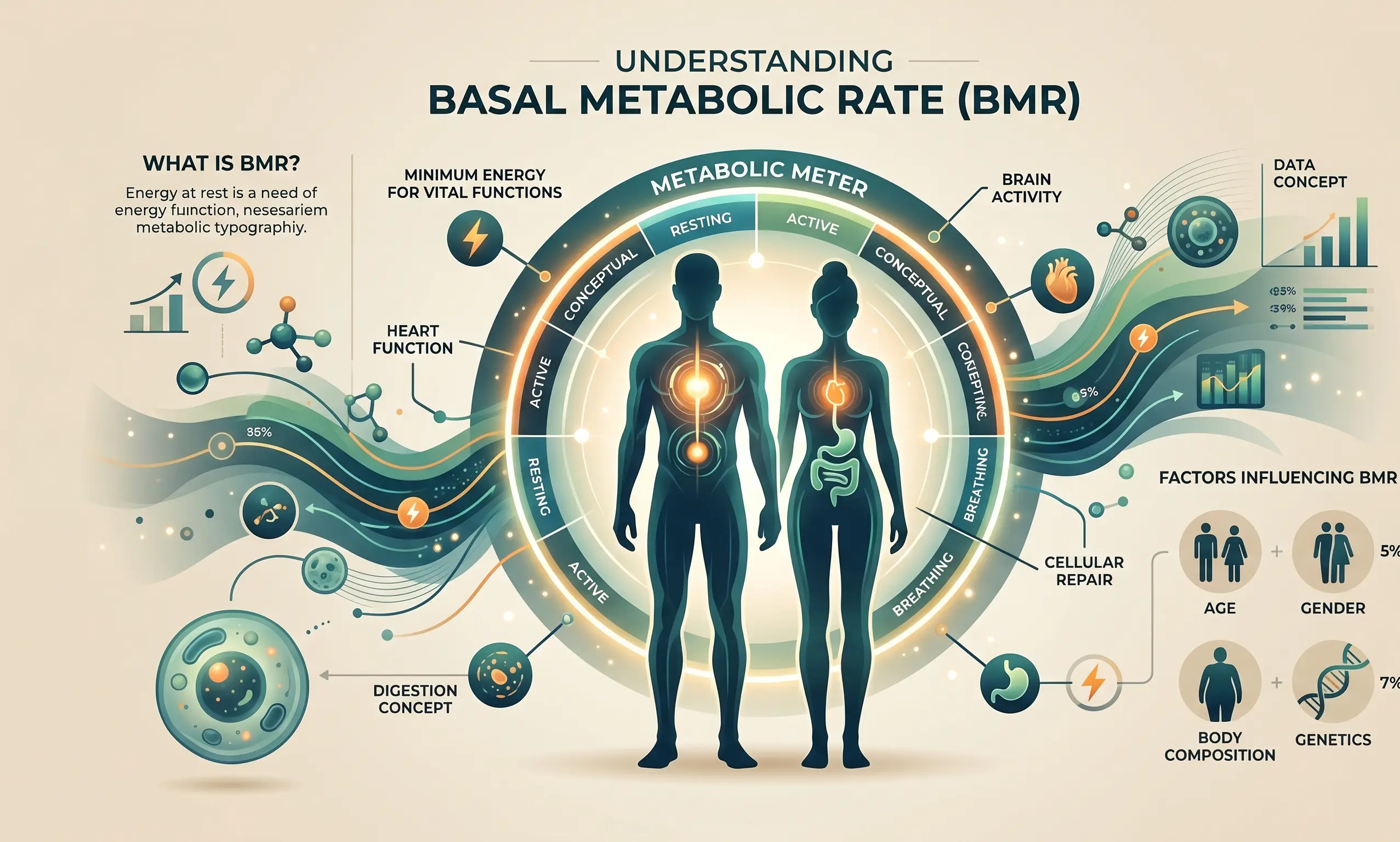
What is basal metabolic rate and how to increase metabolism naturally - these are two of the most important questions in the science of weight management. Your Basal Metabolic Rate (BMR) is the number of calories your body burns at complete rest just to keep you alive: maintaining body temperature, pumping blood, breathing, repairing cells, and sustaining organ function. It accounts for roughly 60-75% of your total daily energy expenditure for most people.
Understanding your BMR is the essential first step to any calorie management goal - because if you're eating more or less than your true energy needs, you're guessing. Use our free BMR Calculator to calculate your resting metabolic rate using the Mifflin-St Jeor equation, the most accurate predictive formula for the general population.
How BMR Is Calculated - The Mifflin-St Jeor Equation
The most widely validated BMR formula is the Mifflin-St Jeor equation, developed in a landmark 1990 study published in the American Journal of Clinical Nutrition.
For men: BMR = (10 × weight in kg) + (6.25 × height in cm) − (5 × age) + 5
For women: BMR = (10 × weight in kg) + (6.25 × height in cm) − (5 × age) − 161
Example (75 kg man, 175 cm, 30 years old): BMR = (750) + (1,093.75) − (150) + 5 = 1,698.75 kcal/day
This means this person burns approximately 1,699 calories per day at complete rest - before accounting for any movement, exercise, or daily activity.
The Mifflin-St Jeor equation is preferred over the older Harris-Benedict equation (1919) because it was validated against measured oxygen consumption in a more representative population. Research shows it predicts BMR within 10% of actual values for 82% of adults.
What Affects Your BMR?
Body size: The largest determinant. A bigger body requires more energy to maintain. Both height and weight are included in the formula because they correlate with total metabolic tissue.
Muscle mass: Skeletal muscle is metabolically active at rest - it burns approximately 13 kcal per kg per day. This is why two people of the same weight but different body compositions have different BMRs: the more muscular person has a higher resting energy expenditure.
Age: BMR declines by approximately 1-2% per decade after age 30, primarily due to age-related muscle loss (sarcopenia) and hormonal changes. By age 70, BMR may be 15-20% lower than at age 20 at the same body weight.
Sex: Men typically have higher BMRs than women at the same height and weight, primarily because men naturally carry more muscle mass and less body fat. The Mifflin-St Jeor equation accounts for this with the gender-specific constant (+5 for men, −161 for women).
Thyroid function: The thyroid gland regulates metabolic rate through thyroid hormones (T3 and T4). Hypothyroidism (underactive thyroid) can reduce BMR by 10-40%; hyperthyroidism can increase it similarly. If you suspect thyroid issues, see a doctor - no formula can diagnose this.
Genetics: Twin studies suggest 40-70% of metabolic rate variation is heritable. Some people are genetically "metabolically efficient" (burn fewer calories at rest); others are "metabolically inefficient" (burn more).
BMR vs. TDEE - What's the Difference?
BMR = calories burned at complete rest (no movement whatsoever)
TDEE (Total Daily Energy Expenditure) = calories burned in a full day of actual living, including movement, digestion, and exercise
TDEE is calculated by multiplying BMR by an activity multiplier. Use our TDEE Calculator to find yours.
For most people:
- BMR accounts for 60-75% of TDEE
- NEAT (non-exercise movement: fidgeting, walking, standing) = 15-30%
- Exercise = 5-15%
- Thermic effect of food (digesting meals) = 8-10%
How to Increase Your Metabolism Naturally
The most common question - and the most important one to answer honestly: metabolism can be increased, but the magnitude is modest and requires consistent effort.
1. Build and maintain muscle mass (most effective method)
Resistance training increases muscle mass, which directly raises BMR because muscle tissue burns more calories at rest than fat. A 5 kg gain in lean muscle adds approximately 65 extra kcal/day to your BMR - modest but cumulative over years.
More significantly, resistance training creates acute metabolic elevation (EPOC - Excess Post-Exercise Oxygen Consumption) that elevates calorie burn for 24-48 hours after each session.
2. Eat adequate protein
Protein has the highest thermic effect of any macronutrient - 20-35% of protein calories are burned in digestion, compared to 5-10% for carbohydrates and 0-3% for fats. Eating 150 g of protein per day instead of 80 g adds approximately 70-100 extra calories burned through digestion.
High protein intake also preserves muscle mass during calorie restriction, preventing the metabolic adaptation (metabolic slowdown) that occurs when lean mass is lost.
3. Don't eat too little (avoid severe calorie restriction)
Reducing calories triggers adaptive thermogenesis - the body reduces its energy output to compensate for reduced intake. Severe restriction (below 70% of TDEE) can reduce BMR by 10-20% within weeks. This is the physiological reason why crash dieting makes sustained fat loss increasingly difficult.
A moderate deficit of 250-500 kcal below TDEE minimises adaptive thermogenesis.
4. Sleep adequately (7-9 hours)
Sleep deprivation significantly disrupts metabolic hormones. Just one week of sleeping 5.5 hours per night has been shown to reduce the proportion of weight lost as fat by 55% (compared to sleeping 8.5 hours) in a calorie-deficit study. Inadequate sleep also elevates ghrelin (hunger hormone) and reduces leptin (satiety hormone).
5. Increase NEAT (non-exercise activity thermogenesis)
NEAT - the energy you burn through all movement that isn't exercise - is one of the most variable and underestimated components of TDEE. People with high NEAT can burn 350-700 more calories per day than sedentary people of the same size. Strategies: standing desk, taking stairs, walking calls, pacing while thinking.
6. Cold exposure (evidence is limited)
Brown adipose tissue (BAT) - brown fat - burns calories to generate heat. Cold exposure (cold showers, cold rooms) activates BAT. Research shows modest effects: approximately 50-100 additional kcal burned during acute cold exposure. Long-term benefits for metabolic rate are not well established.
Understanding Your BMR Result
If your BMR calculator shows 1,700 kcal, this is the absolute minimum calories your body needs just to stay alive. Eating below this figure for extended periods risks muscle loss, hormonal disruption, nutrient deficiencies, and metabolic adaptation.
Your target calorie intake is your TDEE adjusted for your goal - not your BMR. Use our Calorie Calculator to translate your BMR and activity level into an actionable daily calorie target.
Frequently Asked Questions
Can you increase your BMR? Yes - the most reliable way is increasing muscle mass through resistance training. Other methods (protein intake, NEAT, sleep quality) contribute but have more modest individual effects. Genetics set a ceiling, but most people are well below their genetic ceiling.
Does BMR slow with age? BMR declines by approximately 1-2% per decade, largely due to muscle loss. Much of this age-related metabolic decline is preventable with consistent strength training and adequate protein intake.
Is BMR the same as RMR? BMR and Resting Metabolic Rate (RMR) are similar but slightly different. BMR is measured under strict conditions (post-absorptive state, thermoneutral environment). RMR is measured at rest but after normal daily activities. RMR is typically 10-20% higher than true BMR. Most calculators use BMR terminology but produce RMR-level estimates.
Why is my BMR lower than I expected? Common reasons: lower muscle mass than average, lower body weight than expected, female sex, older age, or possible thyroid insufficiency. Very low BMR estimates (below 1,200 for women, 1,400 for men) warrant medical review.
Does muscle burn more calories than fat? Yes - muscle burns approximately 13 kcal/kg/day at rest; fat burns approximately 4.5 kcal/kg/day. The difference is real but often overstated in popular media. Building 5 kg of muscle adds roughly 65 kcal/day to BMR, not 500.
Sources & Further Reading
RECOMMENDED TOOL
Ready to calculate?
Related Articles

Body Fat Percentage Ranges by Age - What Is Healthy for Men and Women?
Healthy body fat percentage range for men and women by age - including the US Navy measurement method, ACE categories, and what your number actually means.

How to Fix a Ruined Sleep Schedule in 2 Days - Science-Backed Methods
How to fix a ruined sleep schedule in 2 days using evidence-based circadian reset techniques - sleep cycles, light exposure, and strategic timing.

How Many Calories Do You Burn Lifting Weights for an Hour?
The science-backed answer to calorie burn during weight training - TDEE, metabolic rate, and how to calculate your exact daily energy needs.