
How to Fix a Ruined Sleep Schedule in 2 Days - Science-Backed Methods
How to fix a ruined sleep schedule in 2 days using evidence-based circadian reset techniques - sleep cycles, light exposure, and strategic timing.
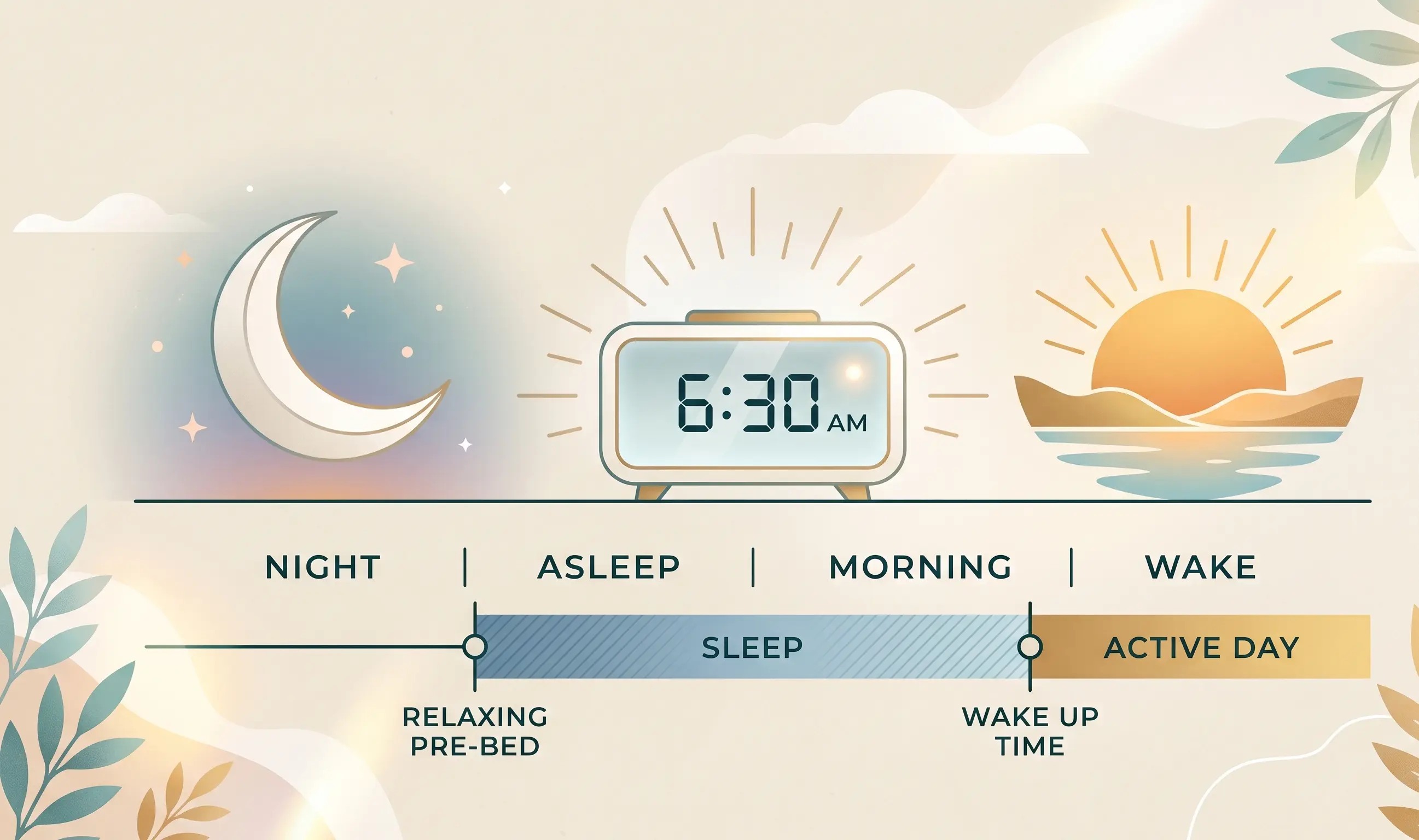
How to fix a ruined sleep schedule in 2 days is the question everyone has after a holiday, a work deadline, or simply months of staying up too late - and the honest answer is that it's possible with the right techniques, but the "2 days" depends heavily on how far off your schedule has drifted. Shifting your circadian rhythm by 1-2 hours is genuinely achievable in 48 hours. Larger shifts (jet lag across many time zones, or years of irregular sleep) take longer. Use our free Sleep Calculator to find your optimal bedtime and wake time based on 90-minute sleep cycles.
Understanding Your Circadian Rhythm
Your circadian rhythm is a roughly 24-hour internal clock that regulates sleep, wakefulness, hormone secretion, body temperature, and dozens of metabolic processes. It's controlled by the suprachiasmatic nucleus (SCN) in the hypothalamus - a cluster of about 20,000 neurons that responds primarily to light and darkness.
The circadian rhythm is not fixed - it shifts in response to external cues called zeitgebers (German for "time givers"). Light is the most powerful zeitgeber. Other zeitgebers include meal timing, exercise, and social interaction.
This is the key insight: to shift your sleep schedule, you must strategically manipulate these cues - particularly light - rather than simply "trying to sleep earlier."
Step 1 - Choose Your Target Sleep/Wake Time
Before attempting a reset, choose a specific target:
- What time do you need to wake up?
- Count back 7.5 hours (5 complete 90-minute sleep cycles) to find your target bedtime.
Example: Need to wake at 6:30 AM → Target bedtime: 11:00 PM
Use our Sleep Calculator to find the optimal bedtime for your wake time, or the optimal wake times if you want to fall asleep at a fixed hour.
The 2-Day Reset Protocol
Day 1 (First Evening)
Step 1 - Bright light avoidance from 2 hours before target bedtime
Light exposure suppresses melatonin - the hormone that signals to your brain that it's time to sleep. Blue light (from screens, LED lighting) is particularly suppressive. Two hours before your target bedtime:
- Dim overhead lights or switch to warm-toned lamps
- Enable night mode on all screens, or use blue light blocking glasses
- Avoid bright bathroom lighting (use a nightlight if possible)
Step 2 - Consistent temperature drop
Core body temperature must fall by approximately 1-2°C to initiate and maintain sleep. Sleeping in a cool room (16-19°C / 61-67°F) dramatically improves sleep quality. A warm bath or shower 1-1.5 hours before bed accelerates the subsequent temperature drop that induces sleepiness.
Step 3 - Commit to your target wake time
Set an alarm for your target wake time regardless of when you fell asleep. This is the single most important intervention. The circadian clock is anchored by consistent wake times far more powerfully than consistent sleep times.
Even if you only got 5 hours of sleep, wake at your target time. The resulting mild sleep pressure makes the following night's sleep easier and more consolidated.
Day 2 (Morning and Day)
Step 4 - Bright light immediately on waking
Expose yourself to bright natural light within 30 minutes of waking. This is the most powerful circadian signal available. Outdoor sunlight (even on a cloudy day) provides 1,000-10,000 lux - far more than indoor lighting (typically 100-500 lux).
- Go outside for 10-20 minutes immediately on waking
- Face the light (don't stare at the sun, just face the direction of light)
- Don't wear sunglasses for this morning light exposure
This bright morning light suppresses melatonin production and sets the "start time" for your circadian clock, ensuring melatonin rises again 12-14 hours later - right around your target bedtime.
Step 5 - Time your first coffee strategically
Adenosine (the molecule that causes sleepiness) builds up throughout the day and clears during sleep. Caffeine works by blocking adenosine receptors.
On your reset day: delay your first coffee by 90-120 minutes after waking. This allows adenosine levels to peak after the night, then caffeine prolongs your alert period. Drinking coffee immediately on waking just delays the adenosine build-up, causing the afternoon energy crash.
Avoid caffeine after 1-2 PM - caffeine has a half-life of approximately 5-6 hours. A 200 mg coffee at 3 PM still has 100 mg active at 9 PM.
Step 6 - Strategic napping (if needed)
If sleep deprivation from night one is severe, a 20-minute nap before 2 PM can restore alertness without disrupting your nighttime sleep pressure. Longer naps (60+ minutes) or later naps (after 3 PM) will make falling asleep at your target time harder.
Understanding Sleep Cycles
Sleep occurs in 90-minute cycles, each containing both NREM (non-REM) and REM stages:
| Stage | Duration | Function | |-------|----------|---------| | NREM Stage 1 | 5-10 min | Light sleep, transition | | NREM Stage 2 | 20 min | Memory consolidation, temperature drop | | NREM Stage 3 (Deep) | 20-40 min | Physical restoration, immune function | | REM | 10-30 min (increasing) | Emotional processing, creativity |
Early cycles are dominated by deep sleep (physical restoration); later cycles contain more REM (cognitive restoration). This is why 6 hours of sleep is not simply "75% as good" as 8 hours - you disproportionately lose the REM-heavy later cycles.
Aim to wake at the end of a complete cycle (90-minute multiple after falling asleep) to minimise grogginess (sleep inertia).
Common Mistakes That Delay Schedule Recovery
Sleeping in to "catch up": Sleeping past your target wake time on weekends perpetuates the cycle. Sleep debt can be partially repaid, but not at the cost of circadian misalignment.
Using alcohol to fall asleep: Alcohol is sedative but dramatically suppresses REM sleep and causes early-morning waking. It worsens overall sleep quality even if it initially accelerates sleep onset.
Avoiding naps entirely on day one: A well-timed 20-minute nap can restore enough function to make the evening manageable without significantly disrupting night two.
Checking the time during waking periods: Knowing it's 3 AM and calculating how many hours remain activates arousal. Keep your phone face-down or covered.
Frequently Asked Questions
Can you fix a sleep schedule in one night? Partially. A single night of consistent wake time plus morning bright light exposure can shift your circadian phase by 1-2 hours. Full consolidation of a new schedule typically requires 3-7 days of consistency.
What is the fastest way to reset your sleep schedule? Wake at your target time consistently, get bright morning light immediately on waking, avoid blue light 2 hours before target bedtime, and keep the bedroom cool (16-19°C). These four steps together produce the fastest circadian realignment.
Does melatonin help reset a sleep schedule? Low-dose melatonin (0.5-3 mg) taken 30-60 minutes before your target bedtime can accelerate circadian shifting, particularly for jet lag or shift work. Higher doses (5-10 mg, common in over-the-counter supplements) don't produce stronger effects and may cause morning grogginess.
How long does it take to fix a reversed sleep schedule? A fully reversed schedule (sleeping during the day, awake at night) typically takes 5-14 days to correct. Use the same principles but with gradual nightly advances of 30-60 minutes rather than an immediate jump.
Is it better to sleep less or miss sleep entirely when resetting? For a 1-2 day reset, strategic sleep restriction followed by a target wake time is more effective than skipping sleep entirely. Total sleep deprivation causes cognitive impairment, which makes evening avoidance of light and arousal harder to maintain.
Sources & Further Reading
RECOMMENDED TOOL
Ready to calculate?
Related Articles

Body Fat Percentage Ranges by Age - What Is Healthy for Men and Women?
Healthy body fat percentage range for men and women by age - including the US Navy measurement method, ACE categories, and what your number actually means.

What Is Basal Metabolic Rate and How Do You Increase Your Metabolism?
What is basal metabolic rate and how to increase metabolism naturally - the science behind BMR, what affects it, and evidence-based methods to boost it.

How Many Calories Do You Burn Lifting Weights for an Hour?
The science-backed answer to calorie burn during weight training - TDEE, metabolic rate, and how to calculate your exact daily energy needs.