
What Day of the Week Was I Born? The Calendar Science Explained
Discover how to find the day of the week you were born on, learn the history of calendar changes, and understand Zeller's congruence.

"What day of the week was I born on?" is a common question. While we all know our birth year, month, and day, many of us don't know the day of the week we were born. Knowing your birth weekday is a fun personal fact, and exploring how it is calculated reveals the history and mathematics of our calendar system. Use our free Day of Week Calculator to find your weekday instantly, and read on to learn the history and math behind the calculation.
Zeller's Congruence: The Weekday Formula
To calculate the day of the week for any date in history, mathematicians use Zeller's Congruence, an algorithm created by Christian Zeller in the late 19th century.
For the Gregorian calendar (which we use today), the formula is:
h = (q + [13*(m+1)/5] + K + [K/4] + [J/4] - 2*J) mod 7
Where:
- h is the day of the week (0 = Saturday, 1 = Sunday, 2 = Monday, 3 = Tuesday, 4 = Wednesday, 5 = Thursday, 6 = Friday).
- q is the day of the month.
- m is the month (with March = 3, April = 4, ..., December = 12. January and February are counted as months 13 and 14 of the previous year).
- K is the year of the century (year mod 100).
- J is the zero-based century (floor of year / 100).
Because of the fractions and modulo math, calculating Zeller's congruence by hand is slow. Our online Day of Week Calculator handles this calculation instantly.
The Julian to Gregorian Calendar Transition
When calculating historical weekdays, it is important to remember that our calendar system has changed over time.
Before 1582, Europe used the Julian calendar, established by Julius Caesar in 45 BC. The Julian calendar assumed a year was exactly 365.25 days long, adding a leap year every four years. However, the solar year is actually slightly shorter: 365.2422 days.
This small difference of 11 minutes per year accumulated over centuries. By 1582, the calendar was 10 days out of alignment with the solar seasons. To correct this, Pope Gregory XIII introduced the Gregorian calendar and adjusted the leap year rules. To get the calendar back in alignment, October 4, 1582, was followed immediately by October 15, 1582.
Because different countries adopted the Gregorian calendar at different times (for example, Great Britain and its colonies adopted it in 1752, and Russia in 1918), calculating weekdays for dates before 1920 requires knowing which calendar was in use in that region at that time. Our calculator uses the standard Gregorian calendar rules for all calculations.
Related Calculators
If you are working with dates, check out these related tools:
- Date Calculator: Add or subtract days, weeks, months, or years to/from any date.
- Day Counter: Calculate the exact number of days or business days between two dates.
- Time Duration Calculator: Calculate elapsed hours, minutes, and seconds between dates.
Find out what day of the week you were born on today using the Day of Week Calculator.
RECOMMENDED TOOL
Ready to calculate?
Related Articles
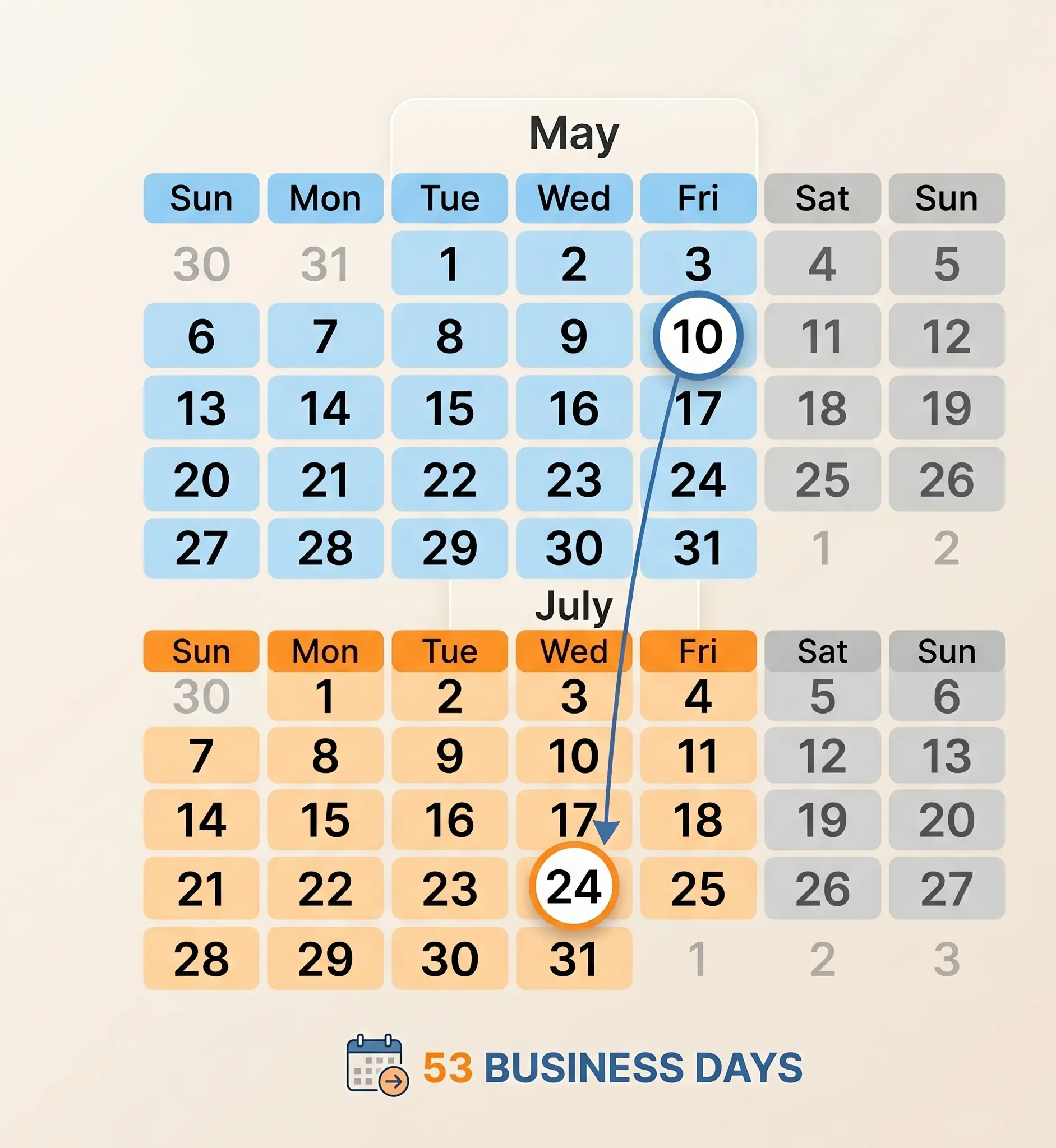
How Many Business Days Between Dates? Working Days Guide
A complete guide on calculating business days between dates, excluding weekends, and managing deadlines and project timelines.
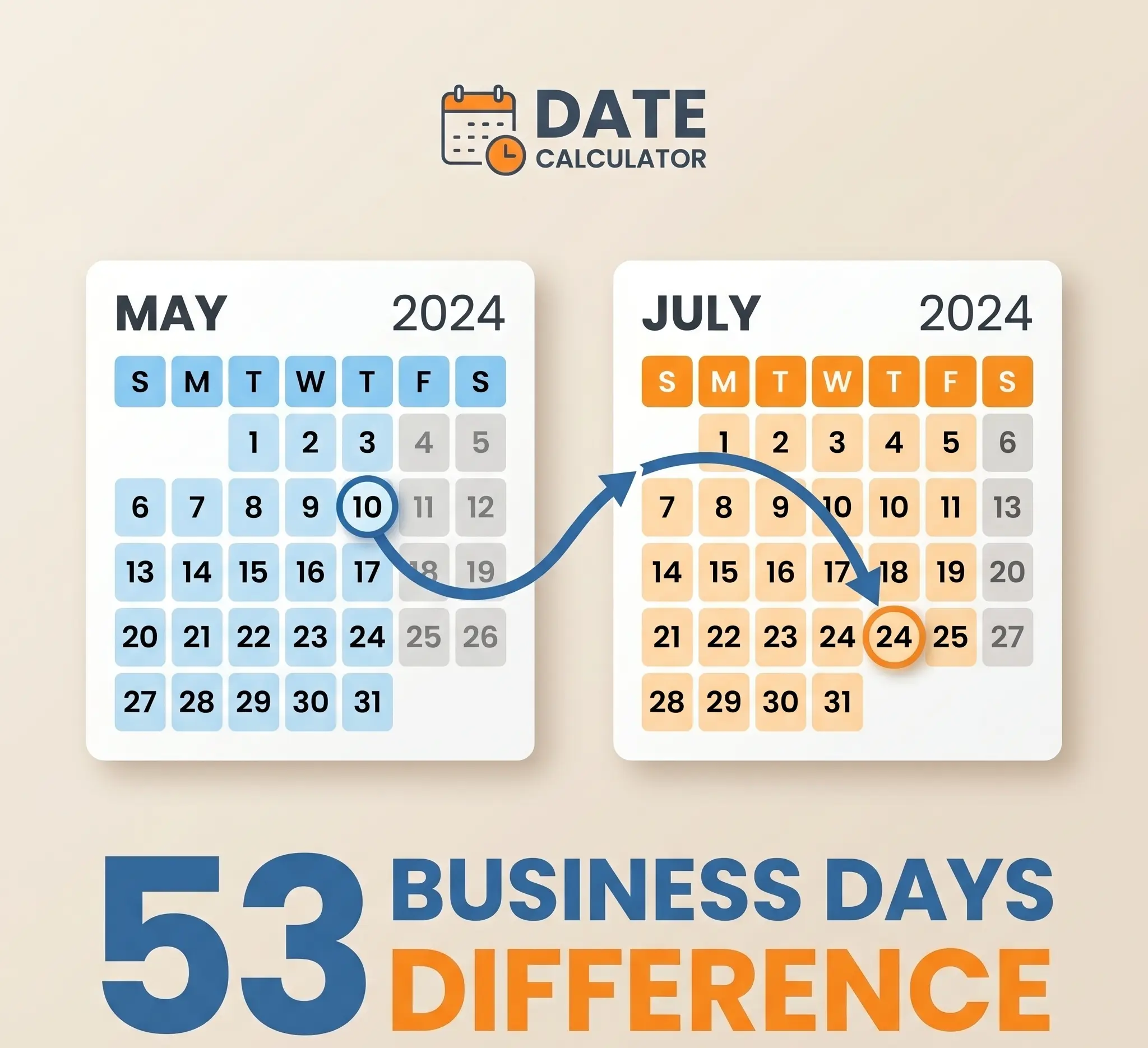
How Many Days Between Two Dates? A Guide to Calendar Calculations
Learn how to calculate the exact number of days between two calendar dates, understand inclusive vs. exclusive counting, and how leap years affect duration.

How Many Hours Between Two Times? Shift & Work Hours Guide
Learn how to calculate the exact hours worked between two times, deduct break times, handle shifts that cross midnight, and convert to decimal hours.