
Is BMI Accurate for Bodybuilders with High Muscle Mass?
BMI classifies many athletes as overweight despite low body fat. Here's why BMI is inaccurate for bodybuilders - and what to use instead.
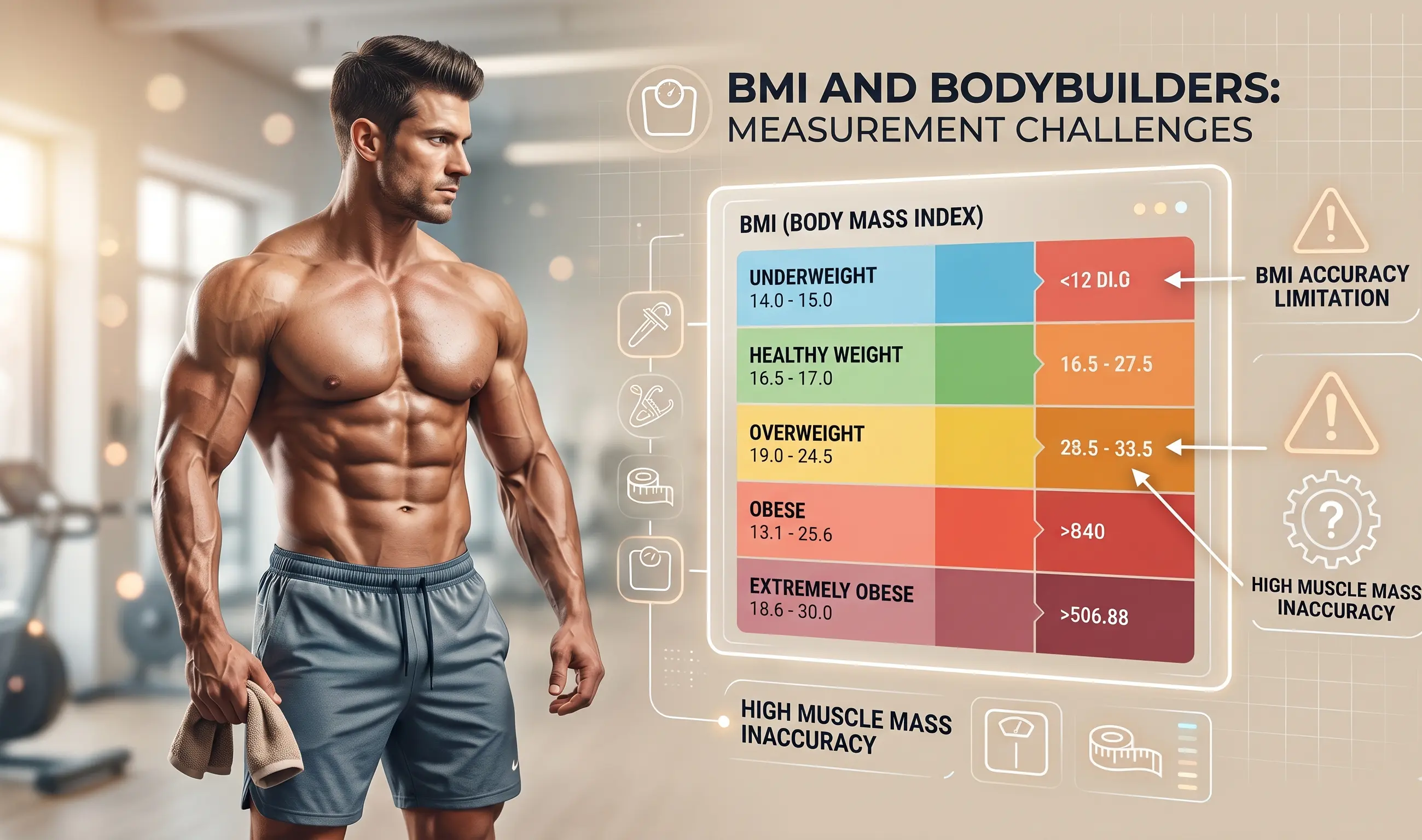
Is BMI accurate for bodybuilders? It's one of the most searched questions in fitness - and the answer matters, because millions of muscular, healthy athletes are classified as "overweight" or even "obese" by a formula that has no idea how much of their weight is muscle versus fat.
The short answer: No, BMI is not accurate for bodybuilders. But understanding why it fails, and what to use instead, will make you a much better judge of your own body composition. Use our free BMI Calculator to find your score, then read on to understand what it actually means if you lift weights regularly.
What BMI Actually Measures (And What It Doesn't)
Body Mass Index was created by Belgian mathematician Adolphe Quetelet in the 1830s - nearly 200 years before modern strength training became mainstream. The formula is elegantly simple: weight (kg) divided by height (m) squared. That simplicity is both its strength and its fatal flaw.
BMI captures one thing: the ratio of your weight to your height. It has no mechanism to distinguish between a kilogram of fat and a kilogram of muscle. A 90 kg man who is 1.80 m tall has a BMI of 27.8 - classified as "Overweight" by WHO standards. Whether that 90 kg is 15% body fat (extremely lean) or 30% body fat (clinically overweight) is completely invisible to the formula.
The formula treats everyone identically regardless of how their weight is distributed, what it's composed of, or how metabolically healthy they are.
The Research on BMI and Muscle Mass
A landmark 2012 study published in the International Journal of Obesity found that BMI misclassified approximately 25% of men with high muscle mass. Athletes who would be categorised as "Normal" by body fat percentage - below 15% - were frequently pushed into the "Overweight" BMI category simply because muscle is denser than fat and adds scale weight.
Professional athletes routinely illustrate this problem. NFL linebackers, Olympic weightlifters, and elite rugby players often carry BMIs of 28-32 despite having single-digit body fat percentages measured by DEXA scan - the gold standard for body composition measurement.
A well-known example: at his peak competitive weight, bodybuilder Ronnie Coleman (8x Mr. Olympia) would have had a BMI approaching 40 - technically classified as "Obese Class II." His body fat at competition was approximately 3-4%.
When BMI Is Useful (And When It Isn't)
BMI remains genuinely useful for population-level screening. In large-scale epidemiological studies tracking millions of people, BMI correlates reasonably well with all-cause mortality, cardiovascular disease risk, and type 2 diabetes incidence. The WHO and most national health systems use it as a first-pass screening tool precisely because it requires no equipment - just a scale and a measuring tape.
For the individual - especially one who trains regularly - BMI works best as a single data point among many, not as a standalone health verdict. If your BMI is 27 and you train four days a week, carry visible muscle definition, and your doctor has no concerns about blood pressure or cholesterol, your BMI number probably tells you very little of clinical value.
BMI is most reliable for:
- Sedentary individuals with average muscle mass
- Population-level research and statistics
- First-pass screening where more precise tests aren't available
- Tracking relative changes in weight-to-height ratio over time
BMI is least reliable for:
- Strength athletes, bodybuilders, and high-level recreational gym-goers
- Elite endurance athletes with low weight but high fitness
- Older adults where muscle loss has occurred
- Some ethnic groups (Asian populations have higher health risk at lower BMI values)
Better Metrics for Bodybuilders and Strength Athletes
If you want to understand your body composition more accurately than BMI allows, consider these alternatives:
Body fat percentage is the most direct measure. It can be assessed by:
- DEXA (Dual-Energy X-ray Absorptiometry) - the gold standard, accurate to ±1-2%. Costs £50-150 per scan.
- Hydrostatic weighing - highly accurate, involves being submerged in water.
- Skinfold callipers - affordable and portable, though accuracy depends heavily on technician skill (±3-5% with a trained tester).
- Bioelectrical impedance scales - convenient but affected by hydration; accuracy varies widely (±5%).
Waist-to-height ratio (WHtR) is an increasingly recognised cardiovascular risk predictor. A ratio below 0.5 (waist circumference is less than half your height) indicates low visceral fat risk, regardless of total weight or BMI. It's simple to measure and takes muscle mass out of the equation entirely.
Fat-Free Mass Index (FFMI) applies the BMI concept specifically to lean mass, removing the distortion caused by high muscle mass. It's calculated as lean mass in kg ÷ height in m². An FFMI above 25 in a natural (drug-free) athlete is considered exceptional. FFMI is used in research to distinguish natural from enhanced physiques.
How to Use LogiCalc's BMI Calculator Correctly
When you use our BMI Calculator, treat the result as a starting point. Here's the right framework:
- Calculate your BMI - note your number and WHO classification.
- Check your waist-to-height ratio - measure your waist at navel height, divide by your height (both in the same unit). Below 0.5 is the target.
- Consider your activity level - a BMI of 26-28 in someone training 4+ times per week is almost certainly not a health concern.
- Use it with your TDEE - our TDEE Calculator and BMR Calculator give you the energy picture. A muscular person's higher BMR reflects the metabolic cost of maintaining more tissue.
If your BMI is in the Overweight range but your waist is below half your height and your bloodwork is clean, your health risk profile is likely low. If both BMI and waist-to-height ratio are elevated, that warrants attention regardless of how much time you spend in the gym.
The Bottom Line
BMI is a population screening tool that has outlived its usefulness as a tool for individuals, particularly athletic ones. It is quick, free, and universally understood - which is why it hasn't been replaced at the population level. But for anyone who lifts weights, plays competitive sport, or has built significant muscle mass, BMI classification should always be interpreted with context.
Use it as one lens, not the whole picture. Pair it with body fat percentage, waist measurements, and metabolic markers for a complete view of your health.
For your most accurate BMI result, use our free BMI Calculator. Then explore our TDEE Calculator to understand your full daily energy needs.
Sources & Further Reading
- WHO BMI classification and obesity fact sheet
- DEXA scan body composition research - NCBI
- Romero-Corral A et al. Accuracy of body mass index to diagnose obesity in the US adult population. International Journal of Obesity. 2008.
RECOMMENDED TOOL
Ready to calculate?
Related Articles

Body Fat Percentage Ranges by Age - What Is Healthy for Men and Women?
Healthy body fat percentage range for men and women by age - including the US Navy measurement method, ACE categories, and what your number actually means.

How to Fix a Ruined Sleep Schedule in 2 Days - Science-Backed Methods
How to fix a ruined sleep schedule in 2 days using evidence-based circadian reset techniques - sleep cycles, light exposure, and strategic timing.
What Is Basal Metabolic Rate and How Do You Increase Your Metabolism?
What is basal metabolic rate and how to increase metabolism naturally - the science behind BMR, what affects it, and evidence-based methods to boost it.