
How to Calculate Percentage Difference Between Two Numbers
How to calculate percentage difference between two numbers formula - the complete guide covering percentage difference vs. percentage change, worked examples, and when to use each.
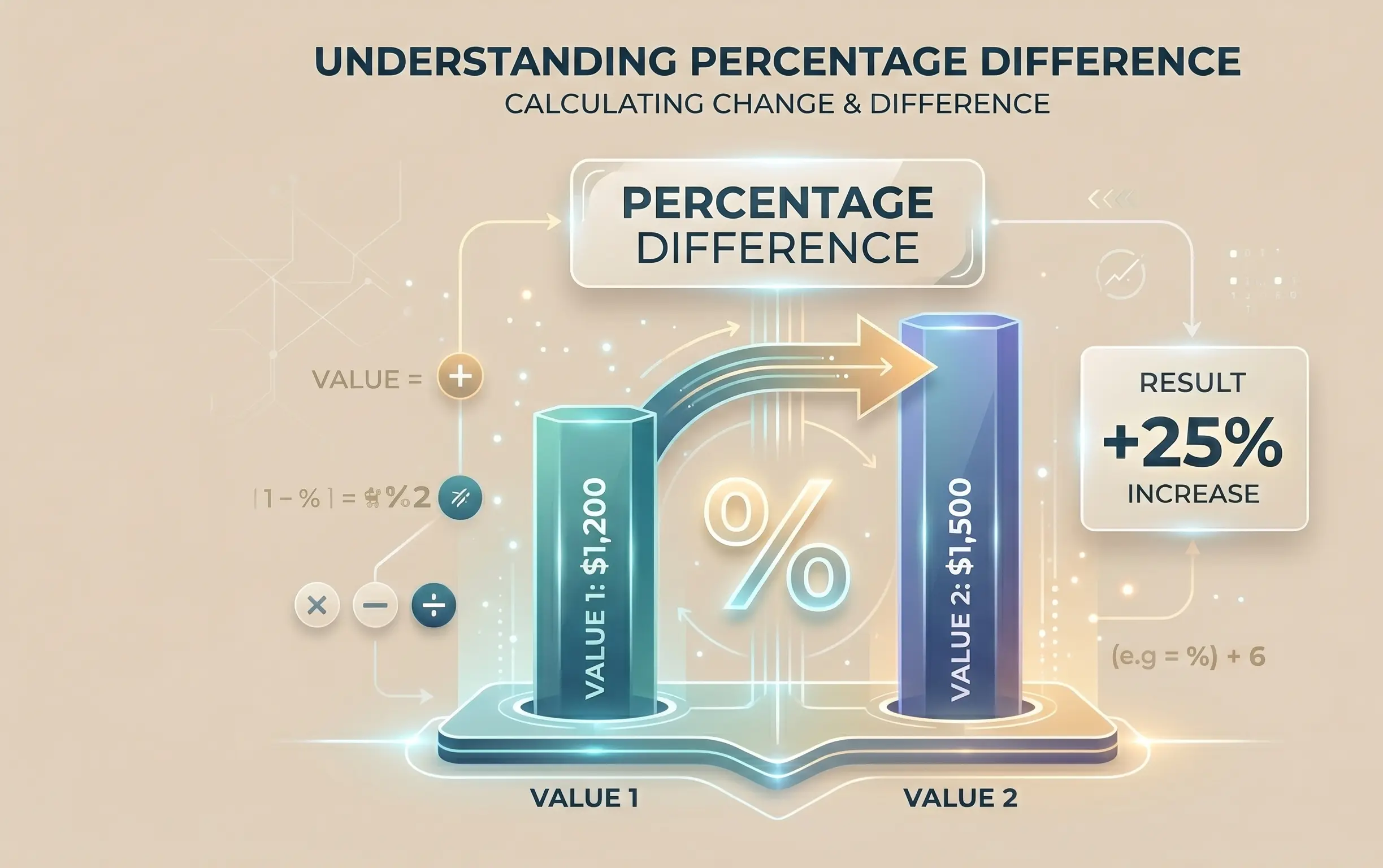
How to calculate percentage difference between two numbers formula is one of the most searched mathematical questions - and it's frequently confused with percentage change, which uses a different formula and answers a different question. Understanding the distinction matters: one formula is symmetric (it doesn't matter which number comes first), while the other is directional. Use our free Percentage Calculator to calculate both instantly with a plain-English interpretation of the result.
Percentage Difference vs. Percentage Change - The Key Distinction
Before diving into the formula, it's important to distinguish between two related but different calculations:
Percentage difference: Measures the relative difference between two values symmetrically - neither value is designated "original" or "new." Result is always positive.
Percentage change (percentage increase/decrease): Measures how much a value has changed relative to a specific starting value. The starting value matters - swapping the values gives a different answer.
Think of it this way:
- "Store A charges £40 and Store B charges £50. What is the percentage difference in price?" → Percentage difference (neither price is the "original")
- "A product's price rose from £40 to £50. What is the percentage change?" → Percentage change (£40 is clearly the original)
The Percentage Difference Formula
Percentage Difference = |V1 − V2| ÷ ((V1 + V2) ÷ 2) × 100
Where:
- V1 and V2 are the two values being compared
- |V1 − V2| is the absolute difference (always positive)
- (V1 + V2) ÷ 2 is the average (arithmetic mean) of the two values
Step-by-step example: percentage difference between 80 and 100
- Calculate absolute difference: |80 − 100| = 20
- Calculate the average: (80 + 100) ÷ 2 = 90
- Divide: 20 ÷ 90 = 0.2222...
- Multiply by 100: 0.2222 × 100 = 22.22%
Note: if you calculate from V1 = 100 and V2 = 80, the result is identical (22.22%). This symmetry is the defining characteristic of percentage difference.
The Percentage Change Formula
Percentage Change = (New Value − Old Value) ÷ Old Value × 100
This formula is directional - the result changes depending on which value you designate as the original.
Example: percentage change from 80 to 100
- (100 − 80) ÷ 80 × 100 = 20 ÷ 80 × 100 = +25% (an increase)
Example: percentage change from 100 to 80
- (80 − 100) ÷ 100 × 100 = −20 ÷ 100 × 100 = −20% (a decrease)
Same two numbers, very different results depending on direction. This is why percentage difference and percentage change are not interchangeable.
Worked Examples - Percentage Difference
Example 1: Comparing two salaries
Salary A: £42,000. Salary B: £58,000.
- |42,000 − 58,000| = 16,000
- (42,000 + 58,000) ÷ 2 = 50,000
- 16,000 ÷ 50,000 × 100 = 32%
Neither salary is "original" - we're simply comparing the two, making percentage difference the right formula.
Example 2: Comparing two store prices
Store A: £15.99. Store B: £12.49.
- |15.99 − 12.49| = 3.50
- (15.99 + 12.49) ÷ 2 = 14.24
- 3.50 ÷ 14.24 × 100 = 24.58%
Example 3: Comparing two test scores
Student A: 74 marks. Student B: 91 marks.
- |74 − 91| = 17
- (74 + 91) ÷ 2 = 82.5
- 17 ÷ 82.5 × 100 = 20.6%
Worked Examples - Percentage Change
Example 1: Price increase
A product rises from £120 to £155.
Percentage change = (155 − 120) ÷ 120 × 100 = 35 ÷ 120 × 100 = +29.17%
Example 2: Weight loss
Body weight drops from 95 kg to 82 kg.
Percentage change = (82 − 95) ÷ 95 × 100 = −13 ÷ 95 × 100 = −13.68%
Example 3: Year-over-year revenue growth
Revenue grows from £2.3M to £2.8M.
Percentage change = (2.8 − 2.3) ÷ 2.3 × 100 = 0.5 ÷ 2.3 × 100 = +21.74%
When to Use Each Formula
| Situation | Use | Formula | |-----------|-----|---------| | Comparing two equal-status values (two prices, two measurements) | Percentage difference | |V1−V2| ÷ ((V1+V2)/2) × 100 | | Tracking change over time (before/after) | Percentage change | (New−Old) ÷ Old × 100 | | Measuring improvement from a baseline | Percentage change | (New−Old) ÷ Old × 100 | | A/B testing comparison | Percentage difference | |V1−V2| ÷ ((V1+V2)/2) × 100 | | Population comparison between two groups | Percentage difference | |V1−V2| ÷ ((V1+V2)/2) × 100 |
The Confusion With "Percentage Points"
Percentage points are a third distinct concept, commonly confused with percentages:
- A tax rate rises from 20% to 22% → it increased by 2 percentage points but increased by 10% in relative terms (2 ÷ 20 × 100 = 10%).
- An approval rating falls from 65% to 55% → it fell by 10 percentage points, or by 15.38% in relative terms.
The distinction matters enormously in contexts like political polling, economic reporting, and medical research, where confusing percentage points and percentages can mislead readers.
The "Percentage Of" Calculation (A Third Type)
There's a third percentage calculation that's often confused with the above:
"What is X% of Y?" → Result = (X ÷ 100) × Y
Example: 15% of £340 = (15 ÷ 100) × 340 = £51.
This is different from both percentage difference and percentage change. Our Percentage Calculator and Fraction Calculator handle all four percentage-related calculations.
Common Mistakes and How to Avoid Them
Mistake 1: Using change formula when difference formula is needed If you calculated price difference between two stores as (B−A)/A × 100, your answer depends on which store you call "A." Use the percentage difference formula to avoid this bias.
Mistake 2: Forgetting the absolute value Percentage difference should always be positive. If you get a negative number, you forgot to take |V1 − V2|.
Mistake 3: Dividing by the wrong base For percentage change, always divide by the original value, not the new value or the average.
Mistake 4: Confusing percentage and percentage points Always check whether a reported percentage refers to a percentage change or an absolute change in percentage points.
Frequently Asked Questions
What is the formula for percentage difference between two numbers? |V1 − V2| ÷ ((V1 + V2) ÷ 2) × 100. This uses the absolute difference divided by the arithmetic mean of the two values.
How is percentage difference different from percentage change? Percentage difference is symmetric - order doesn't matter. Percentage change is directional - you need to specify which value is the original starting point.
Can percentage difference be greater than 100%? Yes - if one value is much larger than the other. For example, comparing 10 and 90: |10−90| = 80, average = 50, percentage difference = 80/50 × 100 = 160%.
What does percentage difference tell you? It tells you how different two values are relative to their average. A small percentage difference means the values are close; a large percentage difference means they're far apart proportionally.
Is there a simpler way to calculate percentage difference? No standard shortcut, but you can verify your answer quickly: if the percentage difference is X%, then the absolute difference should be X% of the average of the two numbers.
Sources & Further Reading
RECOMMENDED TOOL
Ready to calculate?
Related Articles
How to Convert Hexadecimal to Decimal Manually - Full Guide
How to convert hexadecimal to decimal manually step by step - a complete guide covering the positional notation method, worked examples, and hex to binary conversion.
How to Convert Binary to Decimal Step by Step - With Examples
How to convert binary to decimal step by step with examples - a complete guide covering positional notation, the repeated division method, and binary arithmetic explained simply.
How to Add Fractions With Different Denominators - Step by Step
How to add fractions with different denominators step by step - a complete guide covering LCD, simplification, and worked examples for every type of fraction.