
How to Add Fractions With Different Denominators - Step by Step
How to add fractions with different denominators step by step - a complete guide covering LCD, simplification, and worked examples for every type of fraction.
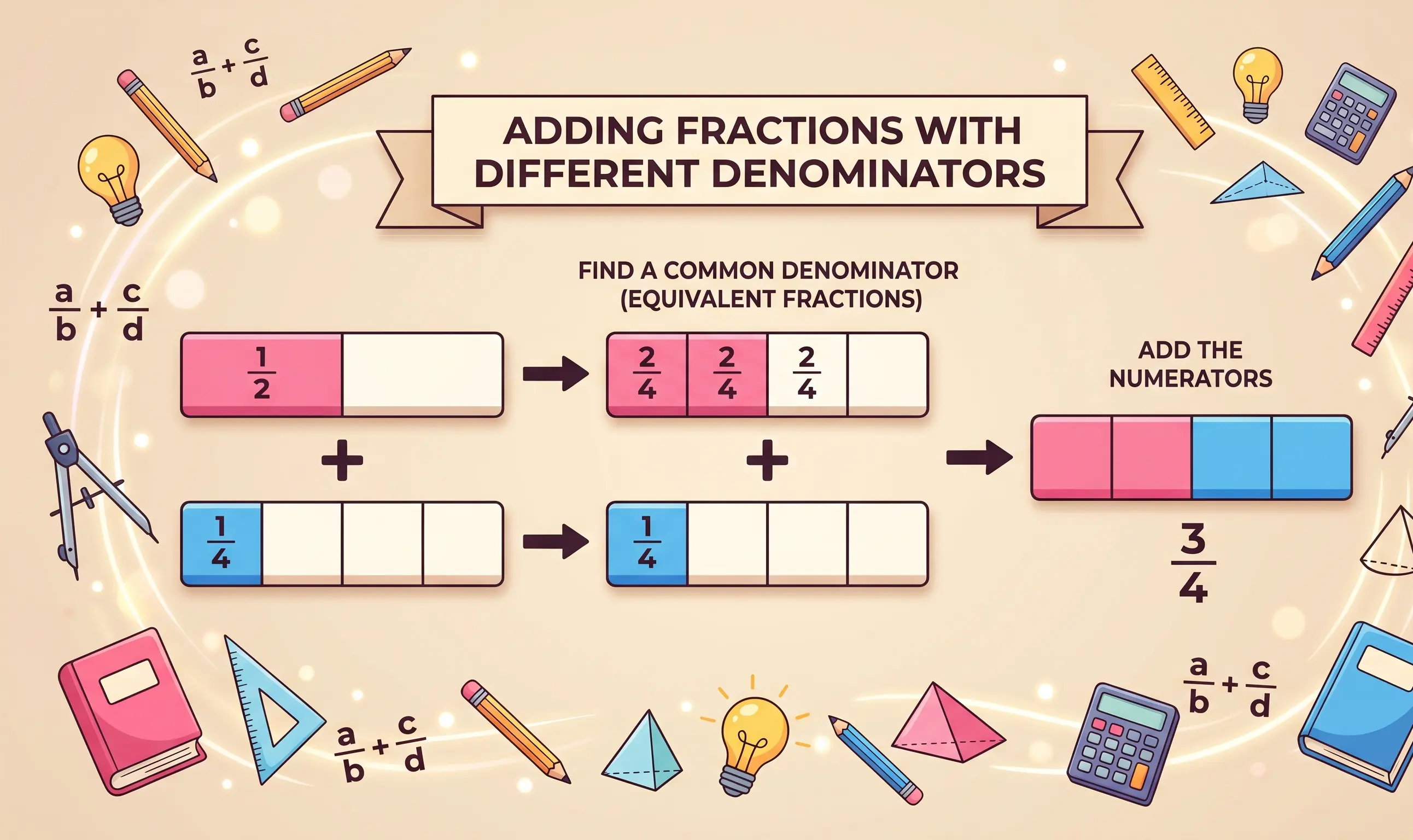
How to add fractions with different denominators step by step is one of the most searched mathematics questions for students and adults alike - because fractions are notoriously tricky when the denominators don't match. The good news is that the method is entirely systematic: find the Lowest Common Denominator, convert both fractions, add the numerators, and simplify. Once you understand why each step works, fraction addition becomes straightforward. Use our free Fraction Calculator to verify your answers instantly.
Why You Can't Just Add Fractions Directly
Before explaining the method, it's worth understanding why you can't simply add the numerators and denominators directly.
Incorrect: 1/3 + 1/4 ≠ 2/7
This doesn't work because fractions with different denominators represent pieces of different sizes. 1/3 means "one piece when the whole is divided into 3 equal parts." 1/4 means "one piece when divided into 4 equal parts." These pieces aren't the same size, so you can't count them together directly.
The solution: convert both fractions so they represent the same-size pieces - that is, give them the same denominator.
Step 1 - Find the Lowest Common Denominator (LCD)
The Lowest Common Denominator is the smallest number that both denominators divide into evenly. It's the Lowest Common Multiple (LCM) of the two denominators.
Method 1: Listing multiples
- Multiples of 3: 3, 6, 9, 12, 15, 18...
- Multiples of 4: 4, 8, 12, 16, 20...
- LCD = 12
Method 2: Prime factorisation
- 3 = 3
- 4 = 2 × 2 = 2²
- LCD = 2² × 3 = 12
Method 3: Formula (for two numbers)
- LCD = (a × b) ÷ GCD(a, b)
- GCD(3, 4) = 1 (they share no common factors)
- LCD = (3 × 4) ÷ 1 = 12
Step 2 - Convert Both Fractions to Equivalent Fractions
To convert each fraction to the LCD denominator, multiply both numerator and denominator by the same number (this keeps the fraction's value unchanged - you're multiplying by 1 in a disguised form).
Converting 1/3 to twelfths:
- 12 ÷ 3 = 4 (multiply factor)
- 1/3 = (1 × 4)/(3 × 4) = 4/12
Converting 1/4 to twelfths:
- 12 ÷ 4 = 3 (multiply factor)
- 1/4 = (1 × 3)/(4 × 3) = 3/12
Step 3 - Add the Numerators
With both fractions now sharing the same denominator, simply add the numerators and keep the denominator:
4/12 + 3/12 = 7/12
Step 4 - Simplify the Result
Check if the result can be simplified by finding the Greatest Common Divisor (GCD) of the numerator and denominator.
7/12: GCD(7, 12) = 1 (7 is prime; 12 is not divisible by 7) Result: 7/12 - already in lowest terms
Worked Examples - Adding Fractions With Different Denominators
Example 1: 3/4 + 1/6
-
Find LCD of 4 and 6:
- Multiples of 4: 4, 8, 12, 16...
- Multiples of 6: 6, 12, 18...
- LCD = 12
-
Convert:
- 3/4 = 9/12 (multiply by 3/3)
- 1/6 = 2/12 (multiply by 2/2)
-
Add: 9/12 + 2/12 = 11/12
-
Simplify: GCD(11, 12) = 1 → Already simplified.
Example 2: 2/5 + 3/8
-
LCD of 5 and 8: 5 and 8 share no common factors, so LCD = 5 × 8 = 40
-
Convert:
- 2/5 = 16/40 (multiply by 8/8)
- 3/8 = 15/40 (multiply by 5/5)
-
Add: 16/40 + 15/40 = 31/40
-
Simplify: GCD(31, 40) = 1 → Already simplified.
Example 3: 5/6 + 7/9
-
LCD of 6 and 9:
- 6 = 2 × 3
- 9 = 3²
- LCD = 2 × 3² = 18
-
Convert:
- 5/6 = 15/18 (multiply by 3/3)
- 7/9 = 14/18 (multiply by 2/2)
-
Add: 15/18 + 14/18 = 29/18
-
Simplify: GCD(29, 18) = 1 → Already simplified. As a mixed number: 29/18 = 1 and 11/18
Adding Mixed Numbers
A mixed number combines a whole number and a fraction (e.g. 2¾). To add mixed numbers:
- Add the whole numbers separately
- Add the fractional parts using the LCD method
- Combine, carrying over if the fraction part is improper
Example: 2¾ + 1⅓
Whole numbers: 2 + 1 = 3
Fractions: 3/4 + 1/3
- LCD = 12
- 9/12 + 4/12 = 13/12 = 1 and 1/12
Combine: 3 + 1 and 1/12 = 4 and 1/12
Adding Three or More Fractions
Find the LCD of all three denominators, convert all fractions, then add all numerators.
Example: 1/2 + 1/3 + 1/6
- LCD = 6
- 3/6 + 2/6 + 1/6 = 6/6 = 1
Common Mistakes to Avoid
| Mistake | Example | Problem | |---------|---------|---------| | Adding denominators | 1/3 + 1/4 = 2/7 | Denominators are not added | | Forgetting to simplify | Leaving 4/8 instead of 1/2 | Always divide by GCD | | Wrong LCD | Using 12 for 4 and 6 (correct) vs. using 24 (works but harder) | LCD is the lowest common multiple | | Not converting both fractions | Converting only one fraction | Both must use the LCD |
Practice Problems
Try these before checking with the Fraction Calculator:
- 1/4 + 3/8 = ?
- 2/3 + 5/12 = ?
- 7/10 + 1/4 = ?
- 1/2 + 1/3 + 1/4 = ?
Answers: (1) 5/8, (2) 3/4, (3) 19/20, (4) 13/12 = 1 and 1/12
Frequently Asked Questions
Why do you need a common denominator to add fractions? Because fractions with different denominators represent different-sized parts. To count them together, you must first convert them to represent the same-sized parts - which is what finding the common denominator achieves.
What if the denominators are the same? If the denominators are already the same, simply add the numerators and keep the denominator: 3/7 + 2/7 = 5/7.
How do you find the LCD of three fractions? Find the LCM of all three denominators. For 1/2, 1/3, 1/5: LCM(2, 3, 5) = 30. The LCD is 30.
Can the LCD be larger than the product of the two denominators? No - the LCD is always less than or equal to the product. It equals the product only when the two denominators share no common factors (i.e. their GCD = 1).
What's the difference between LCD and LCM? LCD (Lowest Common Denominator) is the LCM applied specifically to the denominators of fractions. They are the same concept - "LCD" is just the terminology used in the context of fractions.
Sources & Further Reading
RECOMMENDED TOOL
Ready to calculate?
Related Articles
How to Convert Hexadecimal to Decimal Manually - Full Guide
How to convert hexadecimal to decimal manually step by step - a complete guide covering the positional notation method, worked examples, and hex to binary conversion.
How to Convert Binary to Decimal Step by Step - With Examples
How to convert binary to decimal step by step with examples - a complete guide covering positional notation, the repeated division method, and binary arithmetic explained simply.
How to Calculate Percentage Difference Between Two Numbers
How to calculate percentage difference between two numbers formula - the complete guide covering percentage difference vs. percentage change, worked examples, and when to use each.