
How to Add and Subtract Time (Hours, Minutes, Seconds)
A complete guide on performing time arithmetic, converting between base-60 time units and decimal hours, and solving common time calculations.
%20LogiCalc.webp)
Adding and subtracting time is a common requirement in many fields, from video editing and payroll tracking to flight scheduling and running lap summaries. However, because time is measured in a base-60 system (seconds and minutes) rather than our standard base-10 decimal system, manual time arithmetic is often confusing. Use our free Time Calculator to perform time calculations instantly, and read on to learn how to add and subtract time yourself.
The Base-60 Challenge
In decimal mathematics, values carry over when they reach ten. In time, however, we use a sexagesimal (base-60) system:
- 60 seconds = 1 minute
- 60 minutes = 1 hour
This means that if you add 45 minutes and 30 minutes, you do not get 75 minutes in standard time notation. Instead, you carry over 60 minutes as 1 hour, leaving a remainder of 15 minutes, resulting in 1 hour and 15 minutes.
Standard calculators will fail at this. For example, entering 1.45 + 2.30 on a normal calculator yields 3.75. But 3.75 hours is actually 3 hours and 45 minutes (since $0.75 \times 60 = 45$ minutes), whereas the sum of 1 hour 45 minutes and 2 hours 30 minutes is actually 4 hours and 15 minutes.
How to Add Time Durations Manually
To add two durations of hours, minutes, and seconds manually, follow these steps:
- Add the seconds: Add the seconds column. If the total is 60 or more, divide by 60. Write down the remainder and carry the quotient over to the minutes column.
- Add the minutes: Add the minutes column, including any carried-over minutes. If the total is 60 or more, divide by 60. Write down the remainder and carry the quotient over to the hours column.
- Add the hours: Add the hours column, including any carried-over hours.
Example: Add 2 hours, 45 minutes, 50 seconds + 1 hour, 35 minutes, 20 seconds
- Seconds: $50 + 20 = 70$ seconds. 70 seconds is 1 minute and 10 seconds. (Write down
10, carry over1). - Minutes: $45 + 35 + 1 \text = 81$ minutes. 81 minutes is 1 hour and 21 minutes. (Write down
21, carry over1). - Hours: $2 + 1 + 1 \text = 4$ hours.
- Result: 4 hours, 21 minutes, 10 seconds.
How to Subtract Time Durations Manually
Subtraction follows a similar structure, but requires "borrowing" when a column's value is smaller than the value being subtracted:
- Borrow 1 minute to add 60 seconds to the seconds column.
- Borrow 1 hour to add 60 minutes to the minutes column.
Example: Subtract 3 hours, 15 minutes − 1 hour, 45 minutes
- Minutes: We cannot subtract 45 minutes from 15 minutes. We borrow 1 hour from the 3 hours column, leaving 2 hours. We add 60 minutes to the minutes column: $15 + 60 = 75$ minutes.
- New Subtraction: 2 hours, 75 minutes − 1 hour, 45 minutes.
- Minutes: $75 - 45 = 30$ minutes.
- Hours: $2 - 1 = 1$ hour.
- Result: 1 hour, 30 minutes.
Related Calculators
If you work with time tracking or scheduling, you might also find these tools helpful:
- Hours Calculator: Calculate elapsed hours between start and end times, minus lunch break.
- Time Duration Calculator: Calculate elapsed time between two dates and times.
- Time Zone Converter: Translate times between different UTC offsets.
Save time and avoid math errors by using our free online Time Calculator today.
RECOMMENDED TOOL
Ready to calculate?
Related Articles
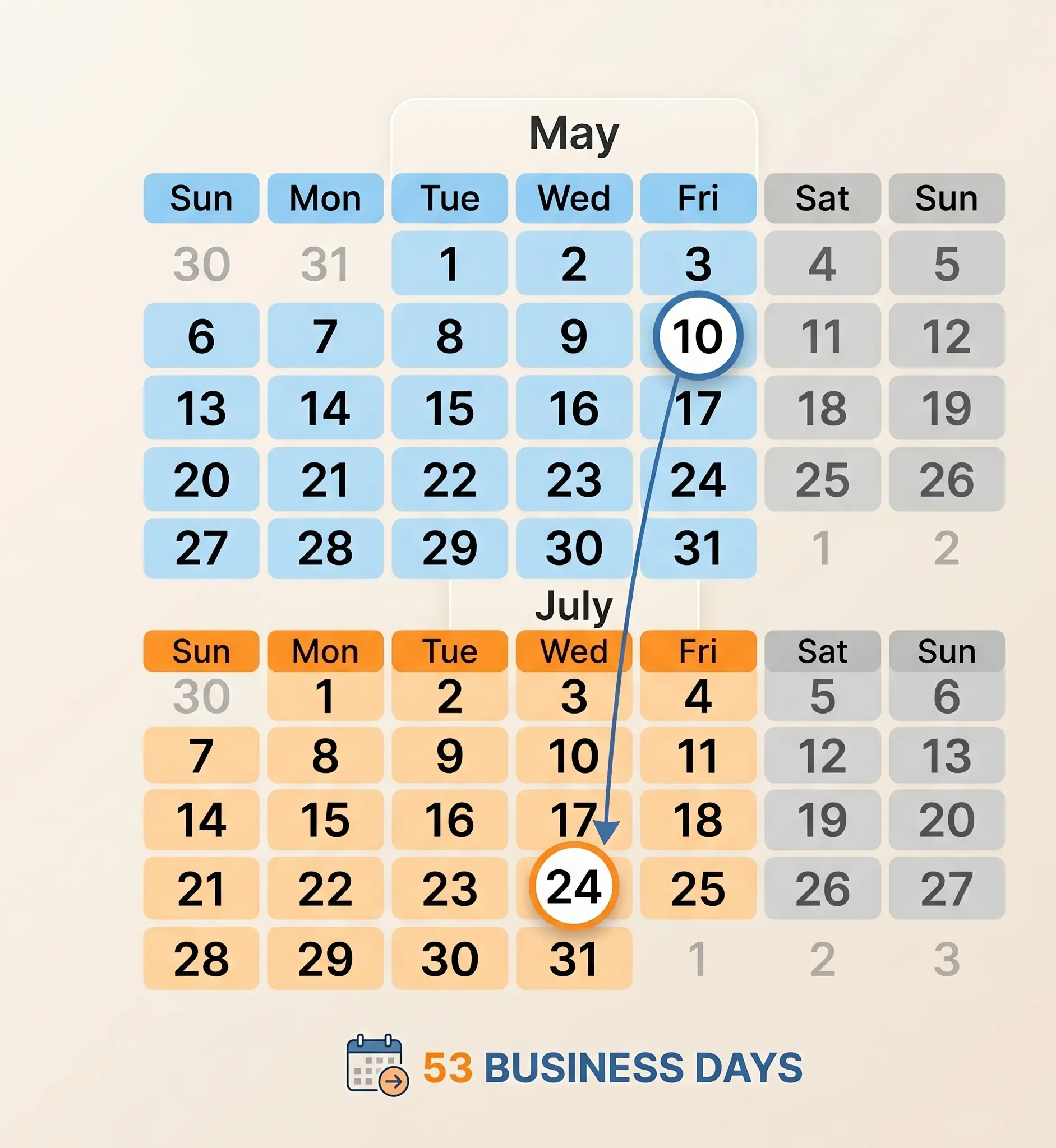
How Many Business Days Between Dates? Working Days Guide
A complete guide on calculating business days between dates, excluding weekends, and managing deadlines and project timelines.
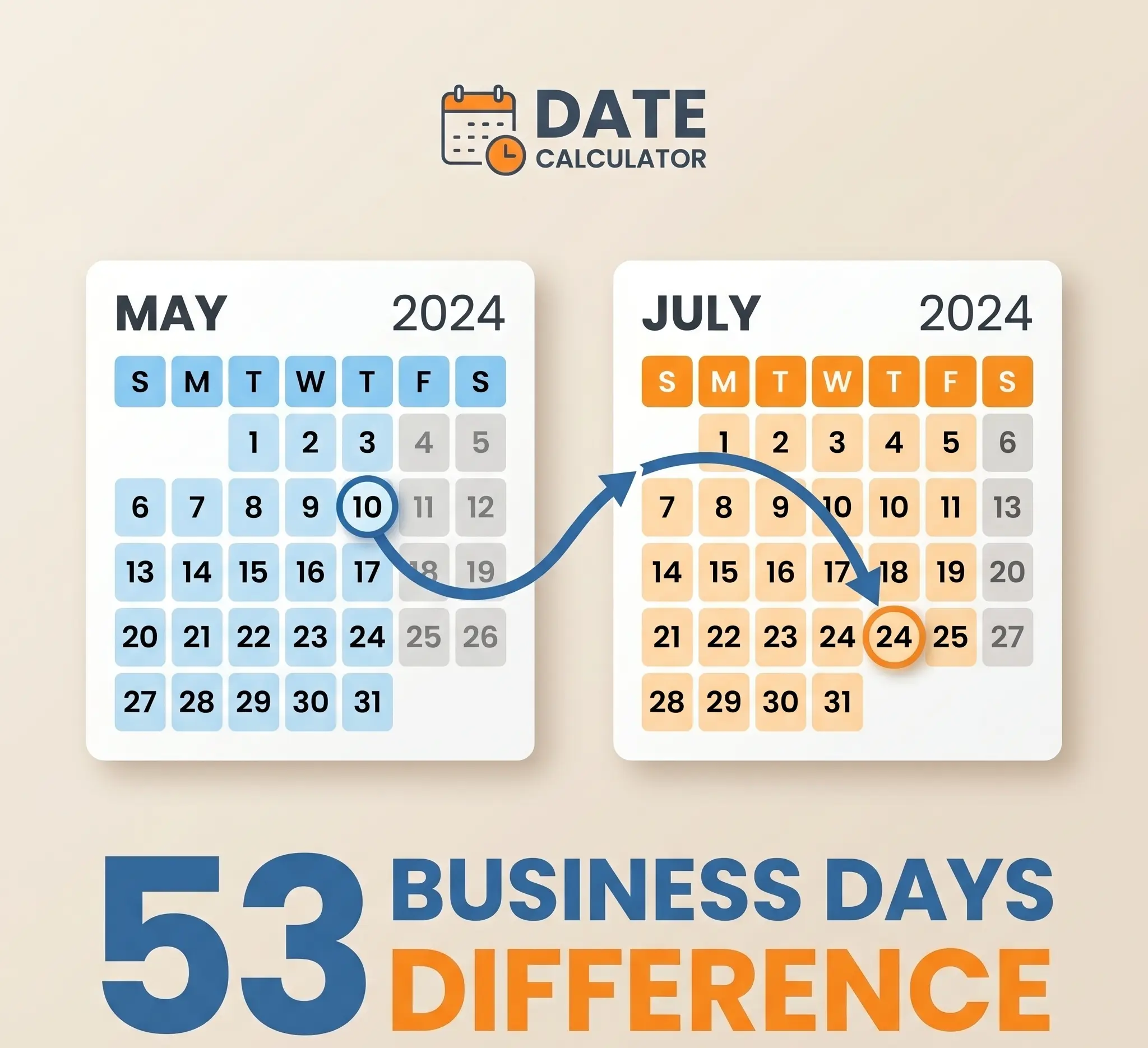
How Many Days Between Two Dates? A Guide to Calendar Calculations
Learn how to calculate the exact number of days between two calendar dates, understand inclusive vs. exclusive counting, and how leap years affect duration.
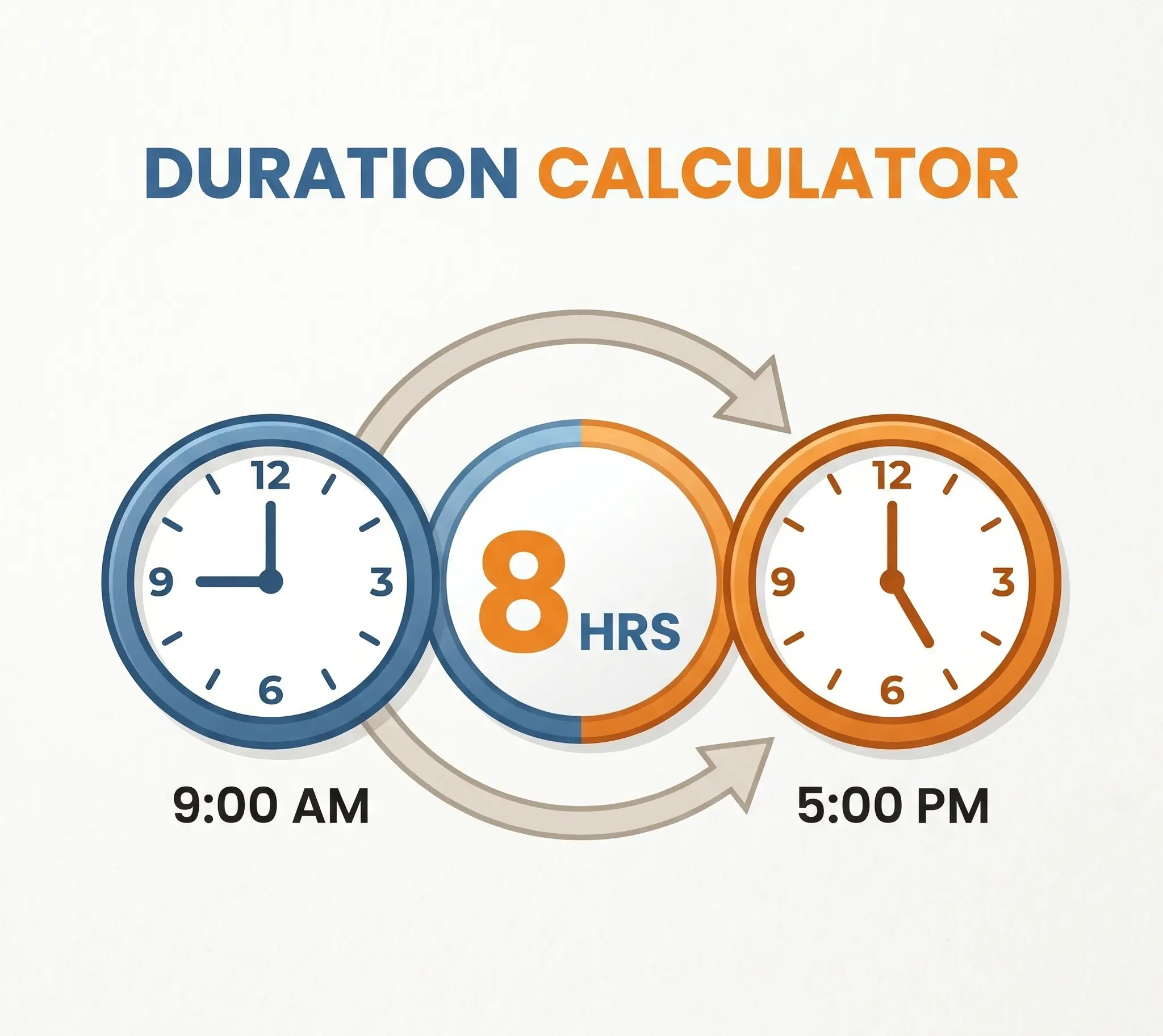
How Many Hours Between Two Times? Shift & Work Hours Guide
Learn how to calculate the exact hours worked between two times, deduct break times, handle shifts that cross midnight, and convert to decimal hours.