
How Many Calories Should You Eat to Lose Weight Without Losing Muscle?
How many calories should I eat to lose weight without losing muscle - the science-backed answer using TDEE, protein targets, and sustainable deficit strategies.
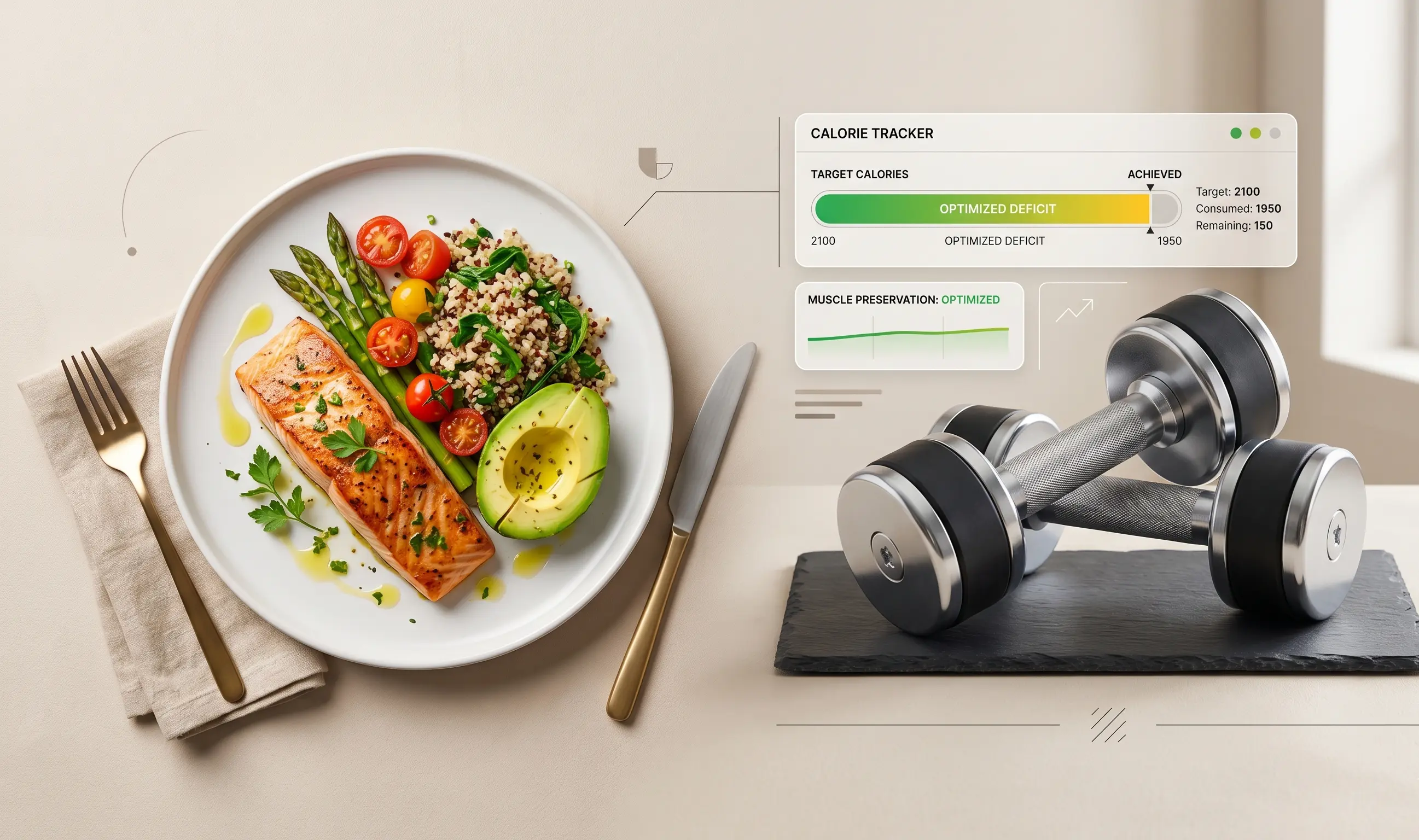
How many calories should I eat to lose weight without losing muscle is the question that separates successful, sustainable fat loss from the endless cycle of crash dieting and rebound. The science is clear: you need a calorie deficit large enough to burn fat, but small enough to preserve lean mass and metabolic rate. Use our free Calorie Calculator to find your personalised daily calorie target based on your goal, weight, and activity level.
The answer for most adults: eat 250-500 kcal per day below your TDEE. This produces 0.25-0.5 kg of fat loss per week - slow enough to preserve muscle, fast enough to see meaningful progress.
Step 1 - Calculate Your TDEE
Before setting a calorie target, you need to know your Total Daily Energy Expenditure (TDEE) - the total number of calories your body burns across an entire day at your current activity level.
TDEE is calculated from your BMR (using the Mifflin-St Jeor equation) multiplied by an activity factor:
| Activity Level | Example | Multiplier | |----------------|---------|-----------| | Sedentary | Desk job, no exercise | BMR × 1.2 | | Light activity | Exercise 1-3 days/week | BMR × 1.375 | | Moderate activity | Exercise 3-5 days/week | BMR × 1.55 | | Very active | Hard training 6-7 days/week | BMR × 1.725 |
For a 75 kg moderately active woman aged 30, height 165 cm:
- BMR ≈ 1,514 kcal/day
- TDEE = 1,514 × 1.55 = 2,347 kcal/day
Her fat loss calorie target would be approximately 1,847-2,097 kcal/day.
Step 2 - Set the Right Deficit Size
The 250-500 kcal/day deficit rule:
- 250 kcal deficit → ~0.25 kg/week loss → Suitable for those with 5-10 kg to lose, or already training hard
- 500 kcal deficit → ~0.5 kg/week loss → Standard recommendation for most people
- 750+ kcal deficit → 0.75+ kg/week → Risk zone for muscle loss; not recommended without medical supervision
Why not eat as little as possible?
Severe restriction (below 70% of TDEE) triggers adaptive thermogenesis - the body deliberately lowers metabolic rate to compensate. Research published in the New England Journal of Medicine documented that participants in the Biggest Loser TV show had BMRs that were still depressed by an average of 499 kcal/day six years after the competition - suggesting severe restriction causes lasting metabolic damage.
A moderate deficit avoids this downward metabolic adaptation while still creating meaningful fat loss.
Step 3 - Set Your Protein Target
Protein is the most critical variable for losing fat without losing muscle. During a calorie deficit, the body may catabolise muscle tissue for energy if protein intake is insufficient.
Target: 1.6-2.4 g of protein per kg of body weight per day.
For a 75 kg person: 120-180 g of protein per day.
A landmark 2012 study found that doubling protein intake in a calorie deficit significantly preserved lean mass compared to standard protein intake - even when total calories were identical. Use our free Protein Calculator to find your exact daily protein target.
Step 4 - Pair Deficit With Resistance Training
A calorie deficit alone will cause weight loss, but without resistance training, approximately 25-30% of that weight will come from muscle. Resistance training provides the mechanical signal that tells your body to preserve and build muscle even when calories are restricted.
Key training principles during a deficit:
- Train each muscle group 2-3 times per week
- Maintain progressive overload (don't dramatically reduce weights)
- Prioritise compound movements (squat, deadlift, press, row)
- Don't simultaneously reduce calories AND volume too aggressively
How Long Will It Take to Lose Weight?
| Calorie Deficit | Weekly Loss | Monthly Loss | Time to Lose 10 kg | |-----------------|-------------|--------------|-------------------| | 250 kcal/day | ~0.25 kg | ~1 kg | ~10 months | | 500 kcal/day | ~0.5 kg | ~2 kg | ~5 months | | 750 kcal/day | ~0.75 kg | ~3 kg | ~3.5 months |
These are estimates based on 1 kg of fat containing approximately 7,700 kcal. Real-world results vary due to water retention, glycogen storage changes, and metabolic adaptation.
What About Calorie Cycling?
Calorie cycling - eating more on training days and less on rest days - is a popular strategy that can help manage hunger and maintain training performance. A typical approach:
- Training days: TDEE − 200 kcal (small deficit)
- Rest days: TDEE − 600 kcal (larger deficit)
- Weekly average: TDEE − ~350 kcal
This approach is particularly useful for athletes who find their training suffers on constant low calories.
Use our Macro Calculator to calculate not just calories but the optimal protein, carb, and fat split for your weight loss goal.
The Role of Diet Breaks
Research on diet breaks - planned periods of eating at maintenance calories within a longer weight loss phase - shows they significantly improve long-term fat loss outcomes. A 2017 Australian study found that participants who took two-week diet breaks during a 16-week diet lost more fat than those who dieted continuously, despite taking time "off" from restriction.
The mechanism: maintenance eating periods partially restore hormones suppressed by calorie restriction (leptin, thyroid hormone, testosterone), allowing the next restriction phase to be more effective.
Avoiding Muscle Loss - The Non-Negotiable Rules
- Eat enough protein - minimum 1.6 g/kg/day, ideally 2.0-2.4 g/kg/day
- Resistance train consistently - 3-4 sessions per week
- Don't deficit too hard - maximum 500 kcal/day for most people
- Eat enough carbohydrates - carbs fuel training; don't drop below 3 g/kg on training days if strength is a priority
- Get adequate sleep - 7-9 hours; sleep deprivation causes muscle breakdown even in the absence of a calorie deficit
Frequently Asked Questions
What is the minimum calories I should eat to lose weight safely? Most clinical guidelines recommend no less than 1,200 kcal/day for women and 1,400 kcal/day for men, and these are lower bounds for supervised medical weight loss. For safe, sustainable loss with muscle preservation, stay within 500 kcal of your TDEE.
Can I lose weight without counting calories? Yes - by focusing on food quality (high protein, high fibre, whole foods) rather than strict counting. However, calorie awareness improves outcomes, and briefly tracking can reveal significant hidden calorie sources.
Why am I not losing weight in a calorie deficit? Most common reasons: (1) underestimated food calories, (2) overestimated activity level in TDEE calculation, (3) water retention masking fat loss, or (4) metabolic adaptation from previous severe restriction. Reassess after 3-4 weeks of consistent tracking.
How much weight should I lose per week? For most people: 0.5-1% of body weight per week. This translates to roughly 0.4-0.8 kg/week for an 80 kg person - sustainable enough to preserve muscle and metabolic rate.
Does the type of food matter, not just calories? Yes - protein, fibre, and whole food sources significantly affect hunger, muscle retention, and hormonal response even at the same calorie level. A 2,000 kcal diet of whole foods with adequate protein produces very different body composition outcomes than 2,000 kcal of processed food.
Sources & Further Reading
RECOMMENDED TOOL
Ready to calculate?
Related Articles

How Much Water Should You Drink While Taking Creatine?
How much water should I drink while taking creatine - the research-backed answer explaining creatine's effect on water distribution and your personalised hydration target.

How Much Water Should I Drink While Taking Creatine?
Creatine increases intracellular water retention. Here's exactly how to adjust your hydration when supplementing - and why it matters for performance and safety.
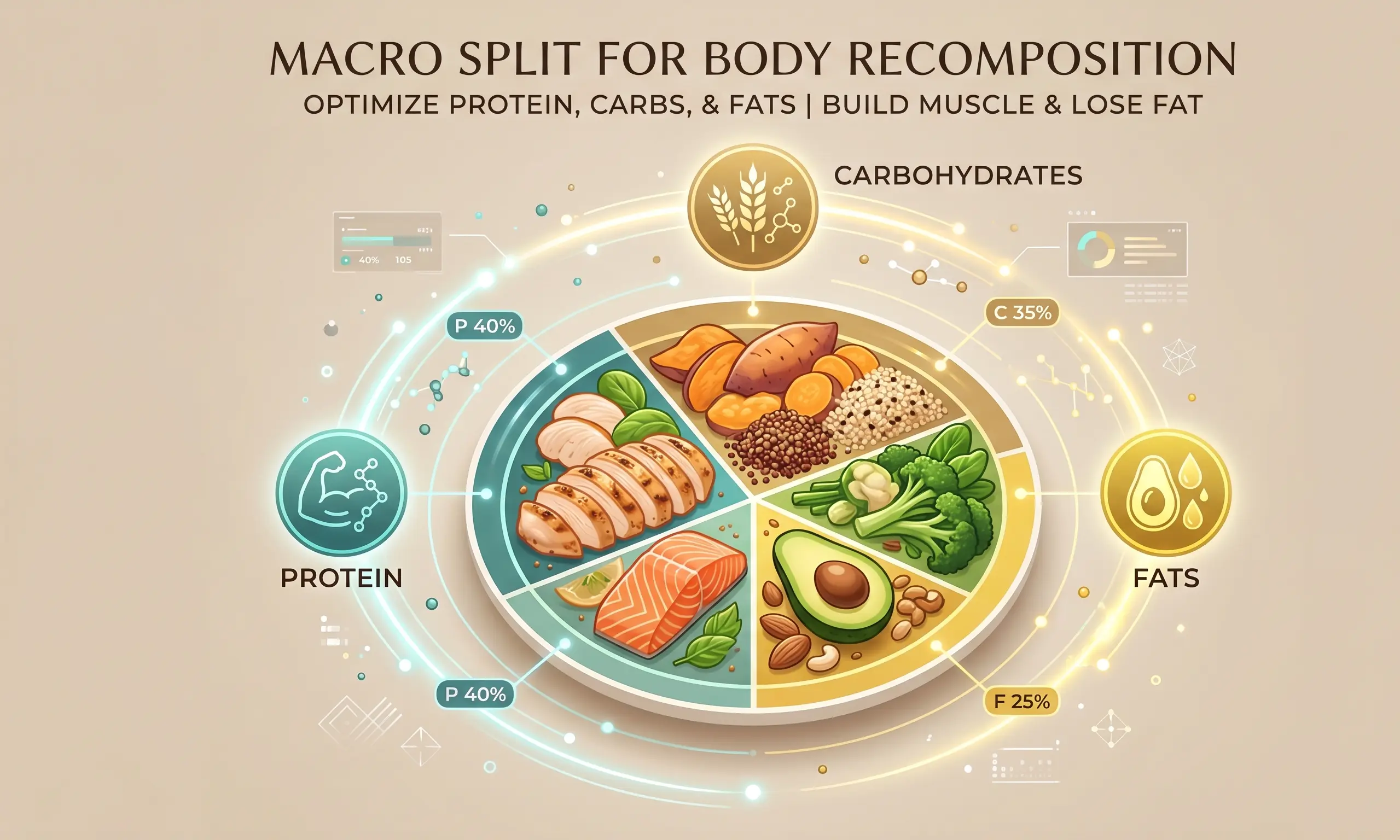
The Best Macro Split for Body Recomposition - Lose Fat and Build Muscle
The best macro split to lose fat and build muscle at the same time requires precise protein targets, strategic carbohydrates, and a specific calorie approach.